
An Inspector Calls: Why Priestley's politics are the most examinable thing in the text
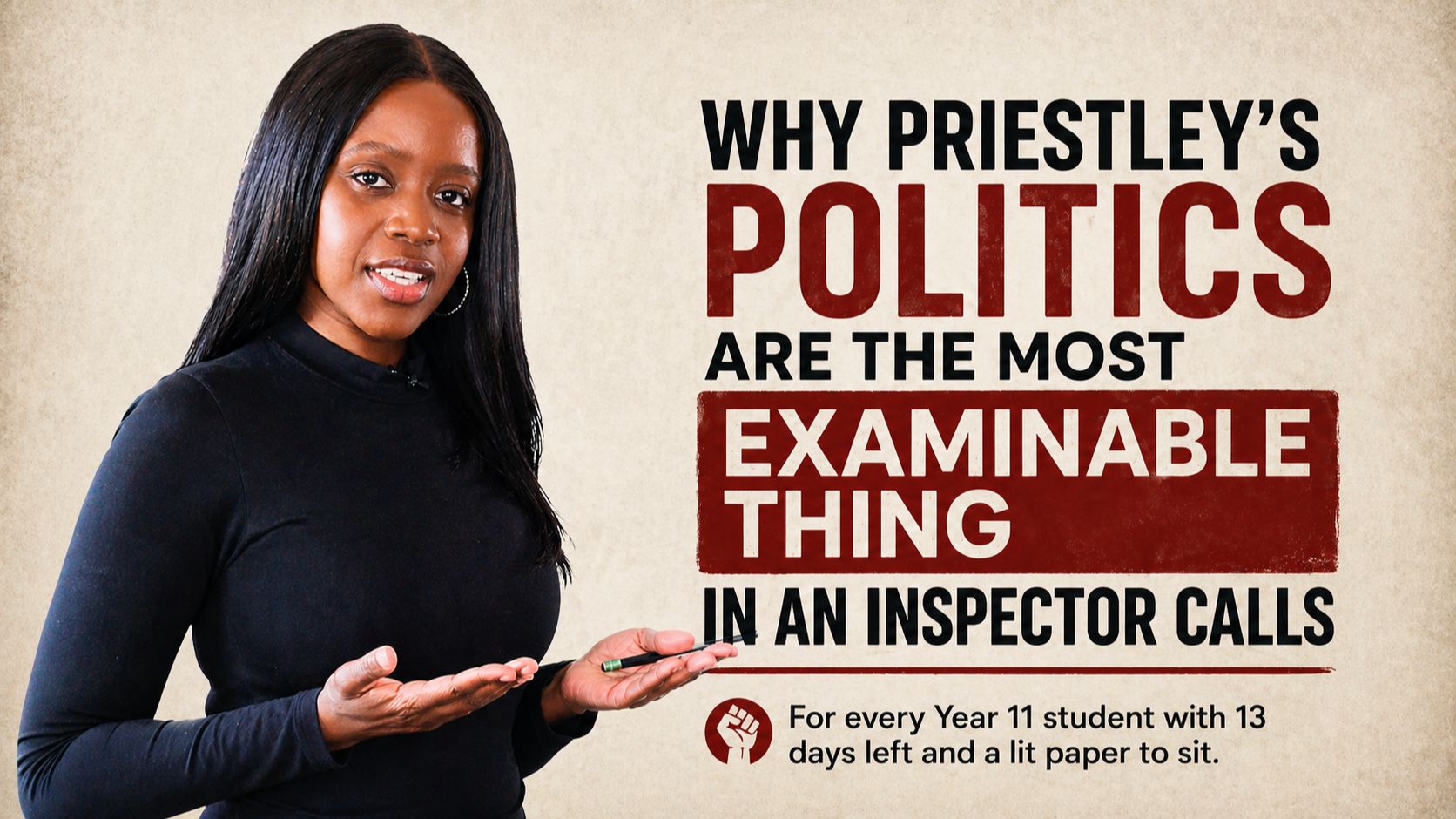
There is a temptation, when revising An Inspector Calls, to treat the play as a collection of character studies, Sheila’s redemption arc, Eric’s alcoholism, Birling’s pomposity, the Inspector’s theatrical exits. And those things matter. But they are, in the deepest sense, vehicles for something larger. Priestley did not write this play to tell you a story about one family on one evening in 1912. He wrote it to argue (loudly, urgently, with the full weight of 1945 behind him) that collective moral responsibility is the only foundation on which a society can stand. That argument is the text. If you understand Priestley’s politics, you understand why every structural choice, every character function, every loaded piece of dialogue exists. And when you understand why something exists, you can write about it with the kind of analytical confidence that earns a Grade 9.
So let’s go deep on the politics and more importantly, on how to weaponise them in your exam response.
Context First
You cannot fully appreciate what Priestley is doing without appreciating when he is doing it. The play was written in 1945 and performed that same year, but it is set in 1912. That gap is deliberate because by 1945, audiences had lived through two world wars, the Great Depression, and the catastrophic consequences of a world organised around selfishness and national pride. Priestley is essentially saying to his audience: here is what the world looked like before all of that and here is why it collapsed.
Thus, the choice of 1912 is pointed. It is the eve of the First World War, the year before everything Birling’s class believed in began to unravel. When Birling famously dismisses the possibility of war and calls the Titanic “unsinkable”. Priestley’s 1945 audience would have laughed, grimly, because they knew exactly what happened next. The dramatic irony is enormous, but its purpose is ideological. Priestley is systematically dismantling the worldview of the pre-war capitalist establishment. He is showing you, in real time, what it looks like when a man’s politics make him incapable of seeing the world clearly.
This is where your analysis gains depth: Birling’s errors of judgement are presented as structurally inevitable, the product of a system that rewards narrow self-interest. His failures of foresight are Priestley’s indictment of capitalism’s epistemological blindness - the idea that if you organise your entire existence around profit and hierarchy, you become genuinely unable to perceive what matters.
Birling as Ideological Straw Man
Birling is, in academic terms, a straw man; a deliberately constructed representation of a position Priestley wants to demolish. This is worth sitting with because students often write about Birling as though he is simply a flawed human being, when he is more accurately described as a walking argument Priestley is staging in order to defeat it.
His philosophy is stated with almost cartoonish clarity: “a man has to mind his own business and look after himself and his own.” This is classical laissez-faire capitalism. The belief that society functions best when individuals pursue their own interests without interference. It is Adam Smith filtered through the arrogance of the Edwardian upper-middle class. And Priestley gives Birling this philosophy in order to show, over the course of the play, precisely how it destroys people.
Eva Smith is the human cost of Birling’s economics. He fired her for striking, for asking to be paid enough to live on, because her demands threatened his profit margins. There is no personal malice in Birling’s decision and that is Priestley’s point. Systemic harm requires no individual villain. The system itself is the villain and Birling is its cheerful, self-congratulatory servant.
The key move in your essay is to link Birling’s personal choices back to his ideological framework. Don’t say he is greedy or selfish and leave it there. Say that his selfishness is principled - he genuinely believes it is the correct way to organise human life and that Priestley’s horror lies precisely in that. The most dangerous ideologues are those who have convinced themselves they are right.
The Inspector as Priestley’s Mouthpiece
The Inspector exists, structurally, as the vehicle for Priestley’s counterargument. Where Birling preaches individualism, the Inspector preaches interconnection. His famous final speech, delivered with the weight of prophecy, is the clearest distillation of Priestley’s socialist politics the play offers, and it is worth knowing it so thoroughly you can quote and analyse it under exam conditions without hesitation.
“We are members of one body. We are responsible for each other.”
This is the theological and political core of the play. The language of the body politic, the idea that society is an organism rather than a collection of competing individuals, is the direct antithesis of Birling’s worldview. Priestley is drawing on a tradition of Christian socialism and collectivist thought that had gained enormous traction in Britain by 1945; the same year the play premiered was the year Labour won a landslide general election and began building the welfare state. Priestley’s audience would have felt the relevance immediately.
The Inspector’s warning that those who refuse to learn this lesson will have it taught to them “in fire and blood and anguish” carries both retrospective and prospective force. Retrospectively, it gestures at the wars that followed 1912. Prospectively, it threatens a future of continued suffering if the post-war settlement fails. Priestley is using his art to make a political argument at a pivotal historical moment, the play is a piece of advocacy as much as it is a drama.
For your essay, the most sophisticated point you can make about the Inspector is that his method mirrors his message. He refuses to allow the Birlings to compartmentalise their responsibility, to say “my involvement ended there and someone else took over.” He insists the chain of cause and effect is unbroken, that each act of carelessness or cruelty flows into the next. This is collectivism enacted as dramatic structure. The Inspector makes the audience feel interconnection before he asks them to accept it as a principle.
The Generational Split as Political Argument
One of the most structurally sophisticated things Priestley does is divide his characters by generation, and, broadly by their capacity for moral transformation. Sheila and Eric accept responsibility; Arthur and Sybil refuse it. Gerald sits awkwardly in between.
This is politics, and it is optimistic politics. Priestley is arguing that the older generation, those whose identities are built on and benefited from the old order, are largely incapable of change. Birling cannot genuinely repent because repentance would require him to dismantle the entire framework through which he understands the world and his place in it. His “morality” is entirely self-referential: he is concerned about scandal and reputation, which are social and financial concepts, and entirely unmoved by the idea that a young woman’s life was broken.
But the younger generation offers hope. Sheila’s transformation is genuine and Priestley signals this through her language. In Act One she is defined by petty jealousy and a certain complicity in upper-class entitlement; her abuse of power at Milwards is small-scale but revealing. By Act Three she refuses to let the mystery of the Inspector’s identity become an excuse to abandon what she has learned: “I tell you - whoever that Inspector was, it was anything but a joke. You knew it then. You began to learn something. And now you’ve stopped.” The shift in her register from passive participant to moral commentator is Priestley’s argument that younger generations, less calcified in their ideology, can be reached.
The political implication is clear. Priestley is addressing a post-war audience in which the young, those who fought, those who survived, had the power to build something new. He is telling them that the Birling generation had its chance and wasted it, and that the responsibility now falls to them. The generational split is a call to action dressed as a family drama.
Class, Power, and Eva Smith’s Function in the Text
Eva Smith is never physically present in the play, and this absence is itself a political statement. The working class exists, in the world Priestley is critiquing, as an abstraction - a source of labour, a problem to be managed, a cost to be minimised. By keeping Eva offstage, Priestley replicates the way people like the Birlings would have related to her: as a case, a name, a file, a decision. She is humanised only through the Inspector’s account of her, which means her humanity depends on someone powerful enough to force the Birlings to look at it.
The name Eva Smith is chosen with care. “Eva” echoes “Eve” - the first woman, the archetype of feminine suffering and vulnerability - and “Smith” is the most common surname in England, signalling that she is every working-class woman, a representative figure rather than a singular victim. Priestley is extending the moral argument outward: this is not a story about one girl who fell through the cracks. It is a story about a system that manufactures those cracks and then blames the people who fall into them.
Her trajectory, from Birling’s factory to Milwards to Gerald’s keeping to Eric’s assault to the charity committee to suicide, is a tour of the ways in which the class system destroys those without power. Each Birling takes something from her and gives her nothing in return, and the cumulative weight of those deprivations is what kills her. This is Priestley’s argument about structural inequality made visceral through narrative. Poverty is shown as a relay race of harm, passed from hand to hand by people who each, individually, might have considered themselves decent.
How to Use the Politics in Your Essay
The question on Paper 1 will ask you about a character, a theme, or a moment in the play, and it will give you an extract to anchor your response. The political framework should infuse everything you write, regardless of the specific question.
If you are asked about Birling, you are being asked about capitalism’s self-satisfaction and its epistemological limits. If you are asked about Sheila, you are being asked about the possibility of political awakening and what it costs. If you are asked about the Inspector, you are being asked about the socialist vision that Priestley is advancing. If you are asked about the ending, you are being asked about Priestley’s unresolved anxiety, his hope for change set against his knowledge that the Birlings of the world are real and persistent.
The most powerful analytical move available to you is to connect the how to the why. Every time you identify a technique, dramatic irony, the Inspector’s interrogation method, Birling’s interrupted speeches, ask yourself what Priestley’s political agenda gains from that choice. Dramatic irony at Birling’s expense undermines the authority of the ruling class. The Inspector’s refusal to be deflected replicates socialist insistence that the powerful cannot talk their way out of responsibility. Birling’s frequent interruptions signal a man whose worldview cannot accommodate challenge.
A top-band response treats the text as a constructed argument, in which every element is purposeful. Priestley did not stumble into his choices. He was a committed socialist writing at a moment when socialist ideas had genuine political traction, and he wanted his art to do ideological work. When you write with that understanding, your analysis moves from description, “Priestley uses dramatic irony” to interpretation, “dramatic irony is Priestley’s mechanism for exposing the ruling class as epistemologically bankrupt, their confidence built on a world that was already ending.”
That is the difference between Grade 5 and Grade 9. Go write it.
If you want more help, I am covering this, and more, in my Inspector Calls Last-Minute Literature Masterclass on Wednesday (5–6pm).
In this class, I’ll show you how to:
-
Answer a An Inspector Calls GCSE Exam Paper
-
Learn how to write a Grade 9 GCSE essay
-
Recap key context and themes - plus how to include them in your exam (not just throw them in and hope for the best).
-
LIVE LESSON RECORDING
You’ll also get predictions, a prediction table, and a cheat sheet with all the key quotes and themes you need because at this stage, you shouldn’t be re-reading the play, you should be refining what you already know.
If that would be useful, you can join here:
https://www.firstratetutors.com/literature
Good luck in 13 days. The politics are your compass, keep returning to them.
xxx,
Barbara
Stay connected with news and updates!
Join our mailing list to receive the latest news and updates from our team.
Don't worry, your information will not be shared.
We hate SPAM. We will never sell your information, for any reason.
