
A Christmas Carol is a gift. Don't waste it.
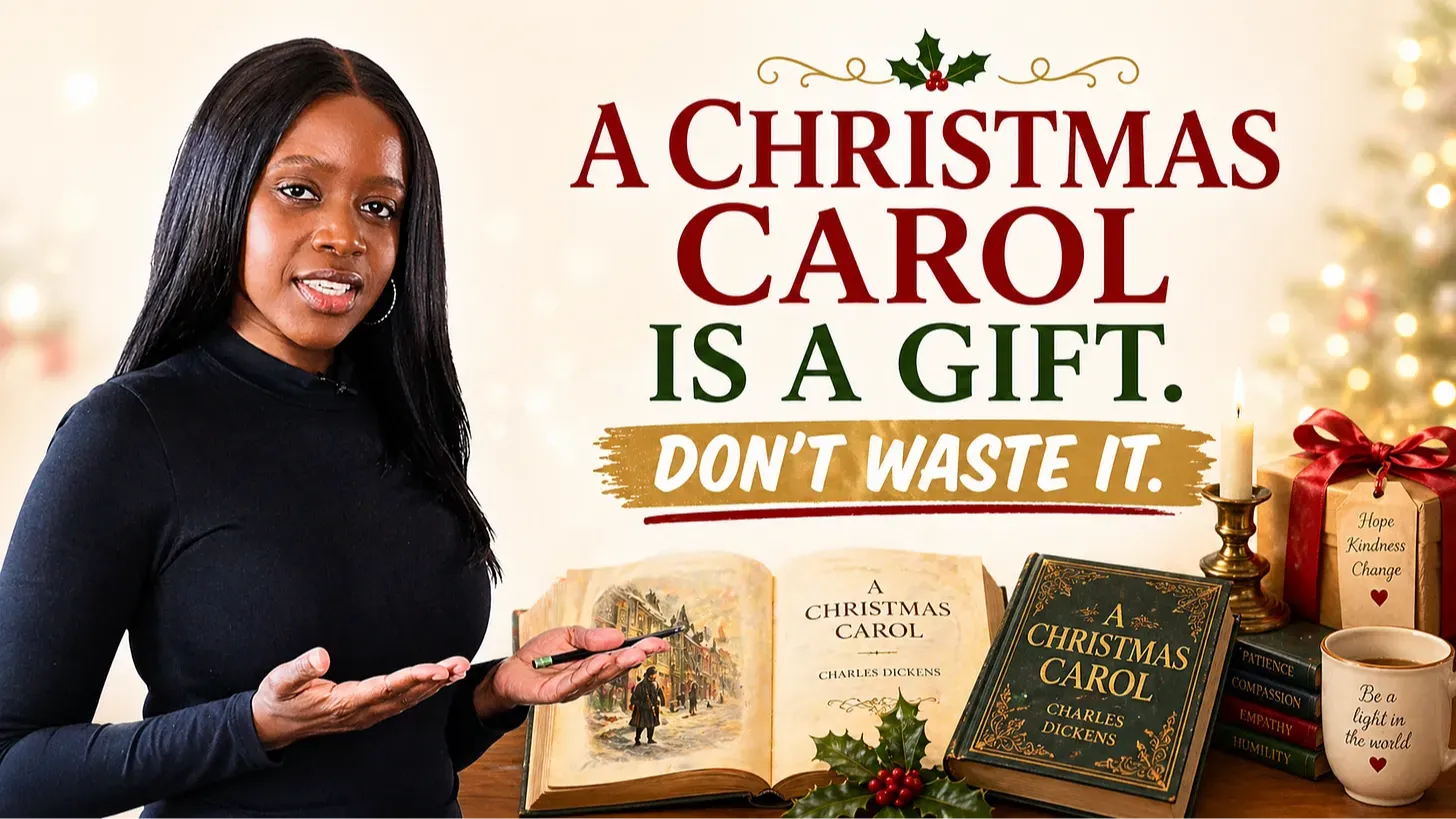
Of all the texts on the GCSE English Literature syllabus, A Christmas Carol is the one students tend to move through too quickly. It is usually because the plot feels familiar, almost predictable, which makes it easy to settle into retelling what happens rather than examining how Dickens is constructing meaning across the novella.
Students often introduce Scrooge through the language of greed, and while that description has some value, it is rarely pushed far enough to become analytically useful. This is because Dickens is working with something broader, a way of thinking that was embedded within Victorian society, particularly in relation to poverty, labour, and responsibility. Scrooge becomes a vehicle through which those ideas can be explored and gradually unsettled.
For instance, when Scrooge refers to prisons and workhouses, he is drawing on the logic of the 1834 Poor Law, where poverty is treated as something to be managed through institutions rather than addressed through collective responsibility, and where those without money are positioned as part of what Malthus would describe as a “surplus population.” That framework matters, because it allows Dickens to position Scrooge within a recognisable social and economic discourse, rather than isolating him as an individual outlier. In doing so, the novella begins to operate as a critique of a wider mindset, rather than a contained character study.
From that point, the structure of the text begins to oscillate between distance and proximity. Scrooge initially maintains a controlled detachment from the lives of others, before being drawn into increasingly intimate encounters that make that detachment more difficult to sustain.
The Ghost of Christmas Past initiates this by returning Scrooge to earlier moments in his own life, where his isolation is presented as something that has developed gradually, shaped by experience, loss, and the quiet prioritisation of security over connection. This is particularly clear in the scene with Belle, where the suggestion that “another idol has displaced me” reframes wealth as something that has taken on emotional significance beyond its material value.
The Ghost of Christmas Present then shifts the focus outward, placing Scrooge within the Cratchit household, where the material limitations of their situation sit alongside a deliberate effort to create warmth and cohesion. This is most clearly captured in the image of “a small pudding for a large family,” which holds both scarcity and care within the same moment.
What emerges here is a tension between Scrooge’s earlier assumptions about the poor and the lived reality presented to him. Dickens sustains that tension rather than resolving it immediately, allowing the reader to observe the gap between ideology and experience.
This develops further through the introduction of Ignorance and Want, whose physical description, “yellow, meagre, ragged, scowling,” grounds social conditions in something visible and immediate, drawing attention to the consequences of sustained neglect and the way in which these conditions are produced and maintained over time.
At this stage, the focus extends beyond Scrooge as an individual and towards the structures that enable such conditions to persist. This reinforces the idea that Dickens is engaging with a broader social question, rather than resolving a single moral failing.
By the time Scrooge reaches the final stave, the movement towards change feels cumulative rather than abrupt. It is shaped by a series of encounters that have gradually altered how he understands his relationship to other people, so that when he declares “I am not the man I was,” it signals a shift in perspective rather than a simple change in behaviour.
His actions thereafter, whether raising Bob’s salary or supporting Tiny Tim, function as evidence of that shift. They demonstrate an acceptance of responsibility that aligns with the critique Dickens has been developing throughout the text, where wealth carries an obligation that extends beyond individual gain.
This is often where essays begin to move with more control, when the focus shifts from recounting events to tracing how Dickens constructs and develops an argument across the novella, and how Scrooge’s journey is used to engage with ideas that sit beyond the character himself.
If you want to be able to approach the text in that way, I am covering this in my Christmas Carol Last-Minute Literature Masterclass on Tuesday 5 May (5–6pm).
In this class, I’ll show you how to:
-
Answer a Christmas Carol GCSE Exam Paper
-
Learn how to write a Grade 9 GCSE essay
-
Recap key context and themes - plus how to include them in your exam (not just throw them in and hope for the best).
-
LIVE LESSON RECORDING
You’ll also get predictions, a prediction table, and a cheat sheet with all the key quotes and themes you need because at this stage, you shouldn’t be re-reading the play, you should be refining what you already know.
If that would be useful, you can join here:
https://www.firstratetutors.com/literature
With much seasonal goodwill,
xxx Barbara
Stay connected with news and updates!
Join our mailing list to receive the latest news and updates from our team.
Don't worry, your information will not be shared.
We hate SPAM. We will never sell your information, for any reason.
